How To Convert Numbers To Percentages

Picture this: You’re at a friend’s birthday party, and someone casually drops a fact like, *“Wow, 8 out of 10 people here love pizza—what are the odds?”* You nod along, but th...
Picture this: You’re at a friend’s birthday party, and someone casually drops a fact like, “Wow, 8 out of 10 people here love pizza—what are the odds?” You nod along, but then your brain hits a tiny roadblock: How do I even know if that’s a big deal or just random luck? That’s where percentages come in—they turn numbers into something way easier to chew on.
Percentages are like the secret sauce of everyday life. They help you understand how likely something is, whether it’s deciding if you should trust that “90% off” sale (spoiler: always check the fine print) or figuring out if your coffee order is actually that good. And the best part? Turning numbers into percentages is simpler than you think—once you get the hang of it.
Why Should You Care?
Let’s be real: percentages are everywhere. You see them on nutrition labels, in weather forecasts, even in those “you’re 60% compatible” quizzes you take on your phone. Knowing how to convert numbers to percentages isn’t just about math class—it’s about making smarter choices, faster.
Must Read
Think about it: If your bank says your savings account grew by 2.5% this year, does that sound impressive? Maybe not. But if you see it as 2.5 out of every 100 dollars growing, it starts to feel a little more… real. Percentages give you a quick snapshot of what’s actually happening.
The Basics: What Even Is a Percentage?
A percentage is just a fraction out of 100. That’s it. So when someone says “75% of the class aced the test”, they mean 75 out of every 100 students did great. No big deal, right?
Here’s a fun way to remember it: Imagine you’re at a bake sale where 3 out of 4 cupcakes are chocolate. That’s 75% chocolate cupcakes—because 3 divided by 4 is 0.75, and 0.75 times 100 is 75. Easy, right?
Step 1: Divide by the Total (The Simple Part)
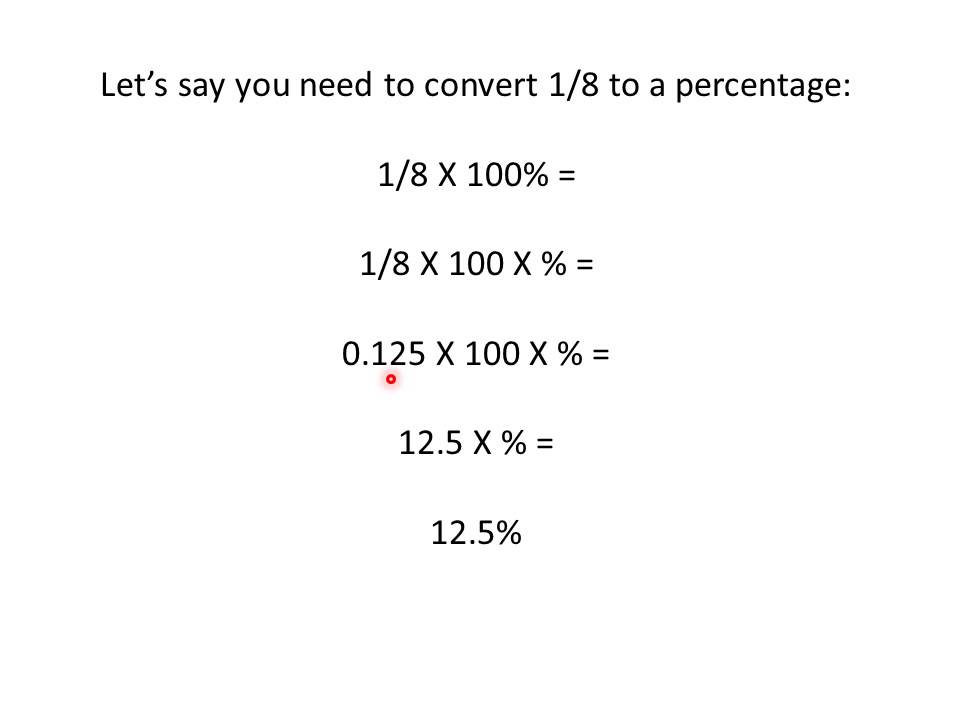
Let’s say you took a quiz and got 9 questions right out of 12. To find your percentage, just divide the number you got right by the total number of questions: 9 ÷ 12 = 0.75. That’s your starting point.
Pro tip: If you’re doing this on paper, always double-check your division. Trust me, there’s nothing worse than realizing you got 90% instead of 75%—and then having to explain to your friend why you didn’t actually crush that test.
Step 2: Multiply by 100 (The Magic Number)
Now, take that decimal and multiply it by 100 to turn it into a percentage. So 0.75 × 100 = 75%. Boom—you just converted a fraction to a percentage in two steps.
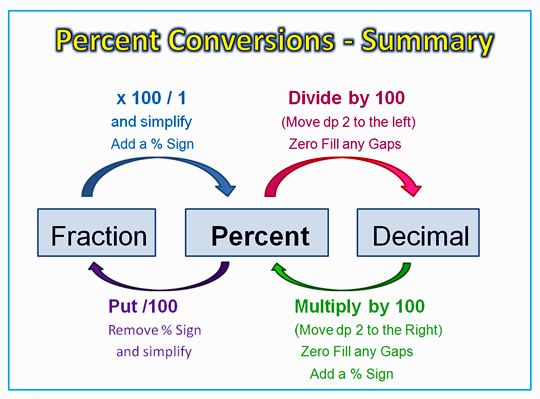 Converting Percentages | Passy's World of Mathematics
Think of it like making a smoothie. You mix your ingredients (division), then you add the right amount of liquid (multiply by 100), and—ta-da—you’ve got a perfect percentage.
Real-Life Examples (Because Math Should Be Fun)
Let’s say you’re at a garage sale and see a shirt marked “50% off.” That means you’re paying half the original price. If the shirt was $20, you’re actually dropping $10—because 50% of 20 is 10. Score!
Or imagine you’re tracking your workout progress. You did 15 push-ups last week and 20 this week. To see how much you improved, divide 20 by 15 (about 1.33), then multiply by 100 to get ~33% better. Now that’s motivation!
When Percentages Go Wrong (And How to Avoid It)
Here’s where things get tricky: not all percentages are created equal. Ever seen a “99% pure” product that still doesn’t work? That’s because percentages can be misleading if the total isn’t clear. A 1% increase in a small number might not mean much, but a 1% increase in a big number (like your salary) is a whole different story.
Always ask: “What’s the total I’m comparing to?” If someone says “My sales went up by 200%!”, that could mean they doubled their sales—or they started from zero and now have $100. Context matters!
Quick Tricks for Fast Conversions
No calculator? No problem. Here are a few mental math hacks to save time:
 How to Convert Decimal to Percent in 2 Easy Steps — Mashup Math
- For 10%: Just move the decimal point one place to the left. So 50 becomes 5, and 200 becomes 20.
- For 5%: Divide by 20. If you got 80 out of 100, 80 ÷ 20 = 4, so 4% is half of 10%. Wait, no—that’s not right. Actually, 80 ÷ 20 = 4, but 4% of 100 is 4, so 80% is 8 times that. Okay, maybe this one’s confusing—stick to the calculator for this one.
- For 15%: Take 10% and add half of 5%. If 10% of $50 is $5, then half of 5% is $2.50. So 15% is $7.50.
Seriously, though—if you’re doing this often, grab a calculator. Your brain will thank you.
Why This Skill Actually Matters
Think percentages are just for math class? Think again. They’re everywhere—in finances, health stats, even social media engagement. If you see a post saying “90% of people love this meme”, you’ll instantly know if it’s a big deal or just a small group of fans.
And here’s the best part: Once you get comfortable, it’s way easier to spot when someone’s trying to pull the wool over your eyes. If a “free” trial has a 99% success rate, but the sample size is just 10 people, you’ll know to take it with a grain of salt.
The Final Test: Try It Yourself
Ready to flex those new skills? Here’s a quick challenge: If you got 18 correct answers out of 25 on a test, what’s your percentage?
Take a guess… then do the math: 18 ÷ 25 = 0.72, and 0.72 × 100 = 72%. Not bad, right? Now you can impress your friends—or at least stop second-guessing that “90% off” sign.
Percentages aren’t just numbers—they’re your secret weapon for making sense of the world. And once you see how easy they are to work with, you’ll start noticing them everywhere. Next thing you know, you’ll be the person everyone turns to when they ask, “How do I even calculate this?”
