How To Know When To Use Sin Cos Or Tan

Remember that one time in high school geometry class when your teacher drew a right-angled triangle on the board and asked, *"Which trig function do we use here?"* You stared...
Remember that one time in high school geometry class when your teacher drew a right-angled triangle on the board and asked, "Which trig function do we use here?" You stared at the triangle like it had just spoken in a foreign language, and suddenly, the whole class was silent—except for the guy in the back who whispered, "Just pick tan, bro." Spoiler: He was wrong. (But hey, at least he tried.)
Trigonometry—trig for short—can feel like trying to solve a puzzle where the pieces keep rearranging themselves. One minute you’re confident, the next you’re Googling "what’s the difference between sine and cosine again?" No judgment. We’ve all been there. The good news? There’s a system to it, and once you crack it, right triangles (and your math grades) will start making way more sense.
Let’s start with the basics: sin, cos, and tan are all about ratios—specific ways to compare the sides of a right triangle. Think of them like different flavors of the same ice cream: they all come from the same sundae, but they taste (and act) differently depending on what you’re craving.
Must Read
Step 1: Draw Your Triangle (Yes, Really)
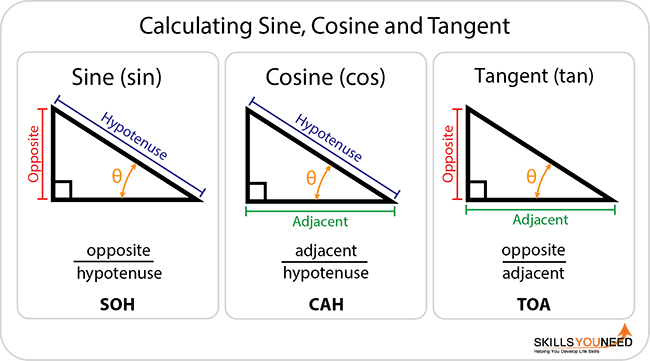
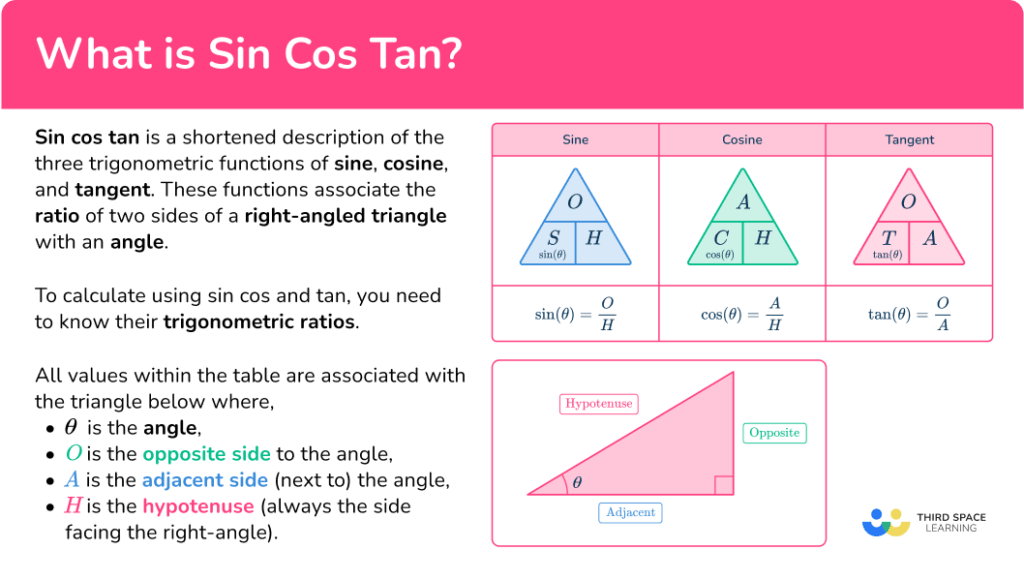
Before you even think about sin or cos, grab a pencil and sketch that right triangle. Label the sides: the hypotenuse (the long side, opposite the right angle), the opposite (the side across from the angle you’re focusing on), and the adjacent (the side that hugs the angle like a best friend).
Pro tip: If your triangle looks like a sad, lopsided rectangle, you might’ve misdrawn it. A right triangle has one 90-degree angle, and the other two should add up to 90 degrees. No pressure.
Visual Checklist:
- ✅ One right angle (90°)
- ✅ Two other angles that aren’t 90°
- ✅ Three sides: hypotenuse, opposite, adjacent
If your triangle passes this test, you’re ready to move on. If not? Go back and try again. (Trust me, your future self will thank you.)
Step 2: The SOH-CAH-TOA Trick (Yes, It’s a Mnemonic)
Here’s where things get fun—or at least less confusing. SOH-CAH-TOA is the secret code to remember which ratio goes with which trig function. It’s like the password to the trigonometry vault.
Break it down:
- SOH: Sine = Opposite / Hypotenuse (Think: "Sine is the side opposite the angle you’re looking at, divided by the hypotenuse.")
- CAH: Cosine = Adjacent / Hypotenuse (Cosine is the side that’s adjacent to the angle, over the hypotenuse.)
- TOA: Tangent = Opposite / Adjacent (Tangent skips the hypotenuse entirely—it’s just opposite over adjacent.)
No, you don’t have to memorize the whole phrase. Just remember: Sine is opposite, cosine is adjacent, and tangent is the wild card that doesn’t care about the hypotenuse.
 Sin Cos Tan - Math Steps, Examples & Questions
Step 3: Ask Yourself: "What Am I Trying to Find?"
Here’s where the magic happens. You’re not just picking a random trig function—you’re solving a specific problem. Ask yourself: What do I know, and what do I need to find? The answer will tell you which ratio to use.
Let’s say you’re given:
- The angle (let’s call it θ)
- The length of the opposite side
- The length of the hypotenuse
You’re asked to find the length of the adjacent side. Which function should you use? Hint: It’s not sine.
If you guessed cosine, you’re on the right track! Because cosine is adjacent over hypotenuse, you can rearrange the equation to solve for the adjacent side. (More on that later—let’s not get ahead of ourselves.)
Quick Cheat Sheet:
You’re looking for:
- An angle? Use arcsin, arccos, or arctan (the "inverse" versions of sine, cosine, and tangent).
- A side length? Pick the function that includes the side you know and the side you’re trying to find.
For example, if you know the opposite and adjacent sides but need the angle, tan is your best friend because it’s opposite over adjacent. Plug in the numbers, hit "inverse tan," and boom—you’ve got your angle.
 Sin Cos Tan - GCSE Maths - Steps, Examples & Worksheet
Step 4: The "Which One Do I Use?" Game
Let’s play a little game. Imagine you’re standing at the base of a ladder leaning against a wall. The ladder is the hypotenuse, the wall is the opposite side, and the ground is the adjacent side.
You want to know how high up the wall the ladder reaches. That’s your opposite side. You know the length of the ladder (hypotenuse) and the distance from the wall (adjacent). Which function should you use?
If you said sine, you’re correct! Because you’re dealing with opposite over hypotenuse. But what if you wanted to know how far from the wall the ladder’s base is? Now you’d use cosine—adjacent over hypotenuse—to find the distance.
Real-Life Scenarios:
- Finding height? Use sine (opposite/hypotenuse).
- Finding distance? Use cosine (adjacent/hypotenuse).
- Finding an angle? Use tangent (opposite/adjacent).
See? Trigonometry isn’t just about triangles—it’s about solving real problems. Whether you’re calculating the angle of a roof, the height of a tree, or how much pizza slice you can fit in your mouth (okay, maybe not that last one), these functions are your tools.
Step 5: Practice Makes Perfect (Or at Least Less Confused)
You wouldn’t expect to master a video game after one playthrough, right? Same goes for trig. Grab a notebook and try these:
- Draw a right triangle with an angle of 30°. The hypotenuse is 10 units. What’s the length of the opposite side?
- You’re given a triangle where the opposite side is 5 and the adjacent side is 7. What’s the angle?
- Bonus challenge: A ladder is 15 feet tall, and the base is 9 feet from the wall. What angle does the ladder make with the ground?
Don’t worry if you mess up. Even the pros had to start somewhere. The key is to keep going. Every time you work through a problem, you’re building muscle memory—and soon, sin, cos, and tan will feel like old friends.
And who knows? Maybe one day, you’ll look at a right triangle and think, "Oh, this one’s a sine problem." without even breaking a sweat. Until then, keep practicing, stay curious, and remember: math is just another language. You’ve got this.
